


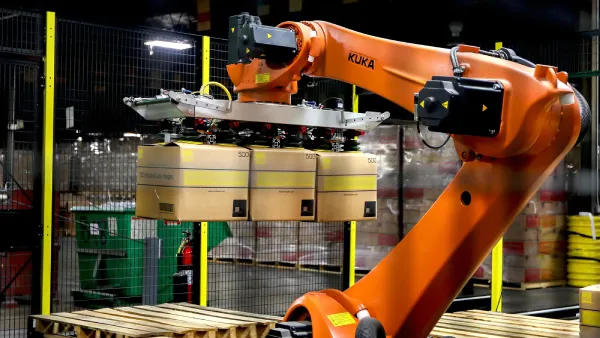
If you are familiar with the activities of manufacturing units, you likely know that palletizing is one of the most common tasks in any production industry. Robotic palletizing solutions, or palletizing using industrial robots, are among the most effective and efficient approaches for this purpose. Robotic palletizing solutions utilize palletizing robots to perform palletizing operations (stacking products on pallets for transportation or other purposes) for various products such as bottles, cans, packages, and more.
Essentially, robotic palletizing is performed layer by layer. In this method, a specialized gripper (robotic claw) is custom-designed for each application.
Robotic palletizing solutions are designed and built to meet the specific needs of each customer, taking into account factors such as line speed, capacity, and other requirements to fulfil the demands of palletizing solutions.
In the following, we will provide a more detailed introduction to this system and its various types.
Which is the Best Palletizing System?
Today, there are many options available for palletizing products. But the question is, how can you choose the right one for your needs?
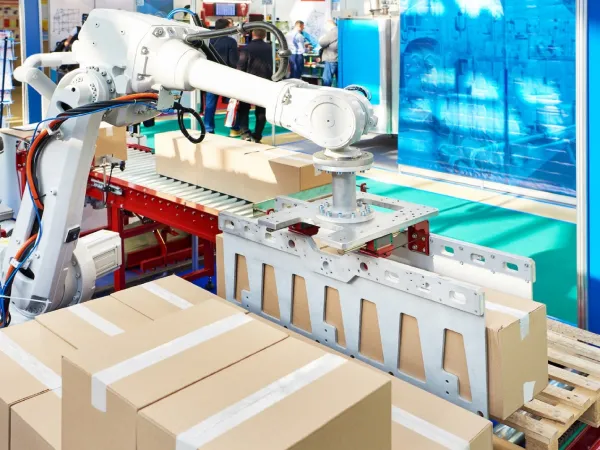
Products to be palletized are fed into the robotic cell via the infeed conveyor system. A pallet is deposited into the pallet loading area either by an automated pallet dispenser or by the palletizing robot. The robot picks one or multiple products at a time, then quickly and accurately places them on a pallet.
Source: bastiansolutions.com
As you are aware, if your packaging process is too slow to keep pace with your production capacity, automating the robotic palletizing stage is the most effective and efficient way to achieve the required throughput.
Additionally, you may believe that mechanical palletizers occupy too much floor space in your factory or lack the flexibility required for the diverse palletizing tasks used in your business. In that case, it can be confidently stated that a robotic palletizing system utilizing a palletizing robot is the optimal solution.
Unlike conventional layer palletizers, a palletizing robot can handle a mix of products in various sizes and shapes on a pallet, enabling you to accomplish your robotic palletizing tasks with a single robot. Moreover, many products suitable for robotic palletizing, such as heavy drums or fragile packages, are not compatible with layer palletizers.
At first glance, a robotic palletizing solution may seem like a straightforward application, leading you to assume that there is only one or two solutions for automating a palletizing process in your business. However, the reality is that a surprisingly wide range of robotic palletizing systems is available, which can greatly benefit your business.
It’s also worth noting that a wide variety of tools can be attached to the robot, allowing you to adapt your robotic palletizing system to handle different products. These include vacuum grippers, customized grippers, and specialized grippers designed for specific applications.
Equipment of Robotic Palletizing Solution System
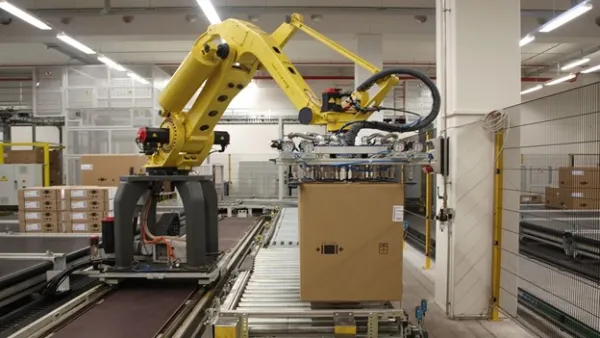
The integrated palletizing system comprises various pieces of equipment. This equipment can vary depending on the type of project, its nature, and the customer’s product.
Below, we will discuss the main equipment commonly used in a robotic palletizing solution system:
Palletizing Robot-
Automatic Pallet Feeder-
Fully Automatic and Semi-Automatic Stretch Wrapper-
-Product Pickup Gripper
Sorter-
Stopper-
Booster Conveyor-
Injection Conveyor-
Transfer Conveyors-
Line Automation System-
And more…-
Finally, incorporating a robotic palletizing system into your final packaging process can enhance your system’s efficiency and free up operators for other tasks. The robotic palletizing system from Tajhiz Sanat Robotic Company offers numerous benefits for your business, which we will explore further below.
Advantages of Robotic Palletizing System
High line speed.-
-High precision with near-zero error rate.
Precise programming capability.-
Real-time reporting capability.-
-Ability to operate continuously 24 hours a day, 7 days a week, 365 days a year without downtime.
Extremely low downtime and failure rate, close to zero.-
Prevention of injuries and harm to human operators.-
Ability to pick products from multiple input conveyors.-
Ability to place products on different pallets.-
Ability to handle multiple product types simultaneously.-
-Reduces cycle time, thereby increasing production, productivity, and, ultimately, customer profit.
-Offline programming software, based on a personal computer, is available as an option to simplify the programming of palletizing applications.
Additional Advantages of Using Robotic Palletizing Solutions
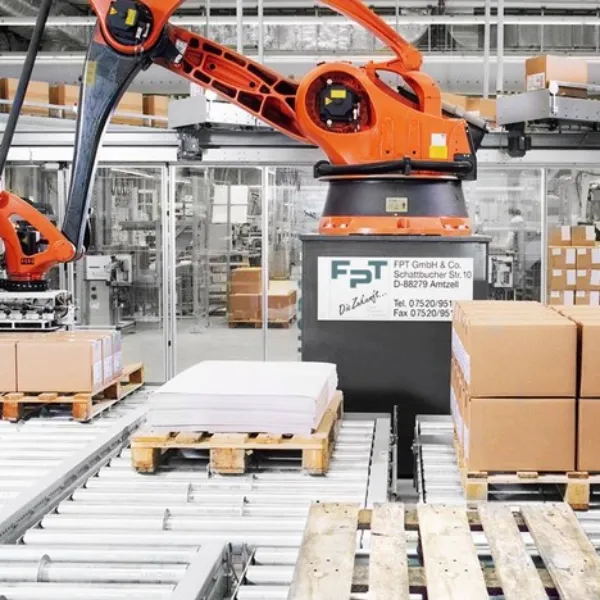
One of the most significant advantages of a palletizing robot is its high operational speed. In this method, you simply place your products on the pallet and witness the rapid execution of the given instructions, including their transportation. Additionally, when using a palletizing robot, the operator can execute the provided instructions precisely and without error. For example, you can adjust the size of the products to your desired specifications, thereby controlling their dimensions. The robotic palletizing solution not only improves production rates but also significantly contributes to reducing potential damages.
Types of Robotic Palletizing Systems
Even after deciding to use a robot for palletizing, you need to select the best type that suits your specific needs. Below are three of the most common types of robots used for palletizing, listed from the least common to the most common:
Six-Axis Industrial Palletizing Robots
Six-axis robots are high-performance industrial robots that offer excellent flexibility, making them ideal for a wide range of tasks, from welding to 3D printing. Using a six-axis industrial robot is not only highly suitable for palletizing but also a great option if you want to use the same robot for tasks beyond palletizing.
Dedicated Palletizing Robots
Likely the best option for most palletizing tasks, a dedicated palletizing robot is typically used. Unlike six-axis industrial robots, these robots usually have only four axes, as the robot’s gripper can only point downward.
Palletizing robots have specifications such as payload capacities ranging from 8 kg to 800 kg. You can easily find a wide range of palletizing robots on our website.
Collaborative Robots
One of the reasons for the growing popularity of collaborative robots is that they are generally smaller industrial robots designed to be completely safe around humans. This increased safety can mean that their performance, particularly in terms of speed and weight capacity, is lower compared to other types of robots.
However, if you’re looking to palletize a small number of products to relieve a worker from the tedious task of palletizing, collaborative robots can be a good choice.
Questions to Help You Choose the Right Robotic Palletizing System
In this section, we will outline several key questions that can assist you in determining which robot model is most suitable for your needs:
-What are the size, shape, and properties of the products the robot will palletize? This helps you determine the robot’s reach and the appropriate tools.
-How much do the products weigh? This helps you determine the robot’s weight capacity.
What throughput do you need? This helps you determine the type of robot.-
-How flexible are your production lines? This indicates how often you need to reprogram the robot.
-Do you need to easily program the robot? If so, selecting the right robot programming software is crucial.
-Will you use the robot solely for palletizing, or do you want it for other purposes? This helps you determine the type of robot.
If you need more information about robotic palletizing solutions, you can contact our experts at the TS Group team for free consultation via the number below: