


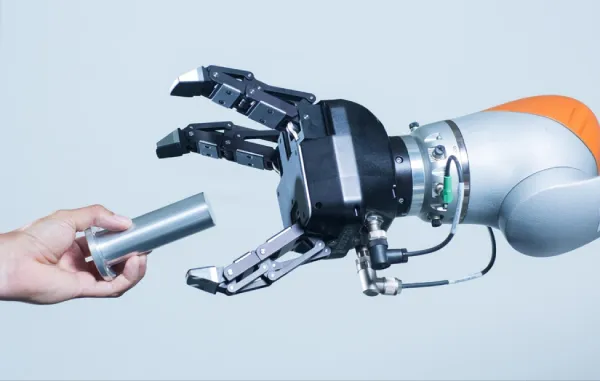
Imagine a promising future where repetitive tasks in laboratories, warehouses, and factories are fully handled by robots, freeing human workers to focus on more creative tasks. Thanks to robotic grippers, this future is closer than you might think. If you’re considering automating your production line, read on: this article will introduce you to robotic grippers and answer all the questions you may have.
What Is a Robotic Gripper?
A robotic gripper is a device attached to the end of a robot arm, enabling the robot to grasp and move objects efficiently. Grippers come in various sizes and materials and are used in different industries based on their specific features. They are commonly employed in sectors like medical, pharmaceutical, and automotive for tasks such as material handling, assembly, packaging, and sorting.
How Do You Attach a Robotic Gripper to a Robot Arm?
There are several ways to attach a gripper to a robot arm. One of the most common methods is to use a gripper mounting assembly: the fixed part is secured to the robot arm, and the movable part connects to the gripper.
Depending on the type of gripper used, you may also need to install additional components on the robot, such as a controller, an actuator (motor) and sensors.
What Types of Robotic Grippers Are There?
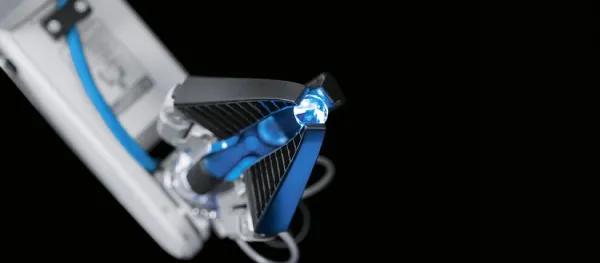
All grippers share the same basic function, but their designs vary depending on their application. Common types include:
Vacuum Gripper
A vacuum (suction) gripper is widely used for stacking and packaging heavier items. It’s generally more cost-effective than other gripper types but is sensitive to dust and has high power consumption.
Pneumatic Gripper
Next, we have the pneumatic gripper, which performs well in tight spaces and offers fast response times. Its main drawback is that it’s unsuitable for mixed parts or very small items.
Hydraulic Gripper
Hydraulic grippers provide high gripping force and are versatile across a wide range of applications. However, they require significant maintenance, and due to the risk of fluid leaks, they are not suitable for handling food or medical products.
Electric Gripper
Electric grippers may lack the force of hydraulic grippers but are ideal for lighter, high-speed tasks. They typically come in two-finger or three-finger versions, suitable for round or cylindrical objects. Their main downsides are their high cost and limited effectiveness for grasping very soft or delicate items.
What Are the Benefits of Using Robotic Grippers?
Using robotic grippers can provide the following benefits:
Higher Throughput
One of the greatest benefits of grippers is their ability to perform repetitive tasks with high speed and precision, significantly boosting production efficiency and output.
Improved Quality
When integrated with advanced sensors and controllers, grippers maintain consistent quality standards throughout the production process, leading to a significant improvement in product quality.
Cost Savings
The initial cost of robots and grippers may surprise you, but the long-term return on investment (ROI) is impressive: labor costs are reduced, and production errors are minimized.
Enhanced Safety
Grippers can replace human labor in hazardous tasks or environments, greatly reducing workplace injuries and incidents.
Versatility
Robotic grippers are highly adaptable and can be used across various industries, such as electronics or healthcare, proving useful in diverse applications.
Learn More About Aluminum Robotic Grippers
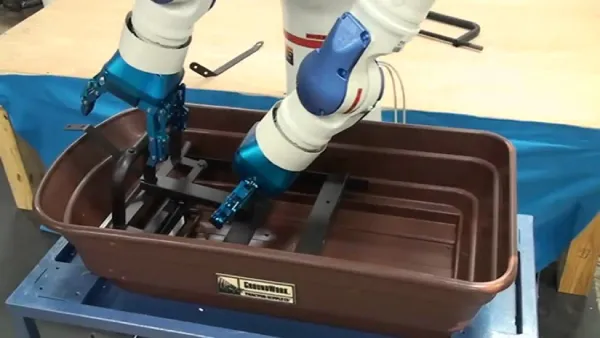
As mentioned earlier, grippers are made from various materials, with aluminum being one of the most widely used. Thanks to its light weight, an aluminum gripper can be easily mounted on a robot arm and perform a variety of tasks. Below, we outline the key advantages and features of aluminum robotic grippers.
High Corrosion Resistance
Aluminum grippers offer strong resistance to corrosion, making them suitable for humid, chemically challenging, or high-temperature environments (up to 300 °C or 572 °F).
Excellent Strength-to-Weight Ratio
Despite their light weight, aluminum robotic grippers are highly robust and capable of handling heavier objects.
Cost-Effective
Compared to stainless steel, titanium, and other materials, aluminum is significantly more affordable, making aluminum grippers a budget-friendly solution for industrial automation.
Note: Aluminum grippers can tolerate temperatures up to 300 °C (572 °F). If the robot’s working environment exceeds this temperature, consider using water-cooling or fan-based thermal management systems.
Applications of Robotic Grippers
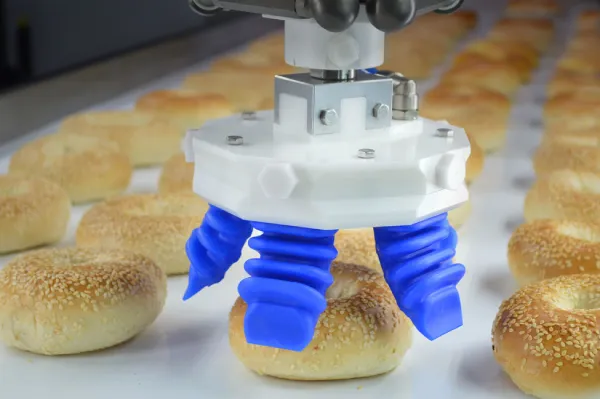
Robotic grippers are used across a wide range of industries. The most prominent industries leveraging this technology include:
| Benefits/Notes | Typical Uses | Industry |
| Simplifies assembly; ensures consistent product quality. | Assembly operations; handling parts on production lines. | Automotive |
| Maintains product quality; minimizes damage; promotes hygiene. | Transfer between processing stages; gentle handling of packaged/unpackaged items. | Food & Beverage |
| Enhances throughput and accuracy in material handling. | Order fulfillment; inventory management; picking, placing, palletizing. | Logistics & Warehousing |
| Promotes cleanliness and repeatability; ensures consistent quality. | Drug packaging; sorting; precise, repeatable tasks. | Pharmaceuticals |
Conclusion
In this article, we discussed robotic grippers and their numerous benefits, including precise product control, adaptability to harsh conditions, high accuracy and speed, cost and time savings, and significant improvements in productivity and safety. They can be effectively used across various industries.
If you’re looking to equip your robots with grippers, contact our experts at TS Group for purchase support and a free consultation. At TS Group, we provide comprehensive support, including training, project implementation, after-sales service, and robot repair and maintenance.
Call: +98 25 361 48
If you have any unanswered questions about robotic grippers, please share them in the comments section, and we’ll respond as quickly as possible.
FAQ
Could a robotic gripper drop a part during operation?
No. Grippers are designed to be robust and function like human fingers. When properly selected, installed, and used, they will not drop items.
Can grippers work in confined spaces?
Yes. Pneumatic grippers with a compact design can effectively operate in small or restricted spaces.