


As you know, robotic welding solutions are one of the most critical and common applications of industrial robots. Robotic welding is considered an essential part of manufacturing factories. This method, which offers many advantages over traditional welding techniques, has attracted significant attention from various businesses. The industrial demand of many companies continues to drive the rapid development of robotic welding solutions and related technologies, which keeps expanding their capabilities to overcome technical challenges.
Our team at Tajhiz Sanat Electronic Company, by offering the finest and highest-quality products alongside exceptional after-sales services, will support you in enhancing your production unit. In this article, we aim to highlight all the essential information you need to know about this system. For further assistance and consultation, feel free to reach out to our colleagues.
What Are Welding Robots?
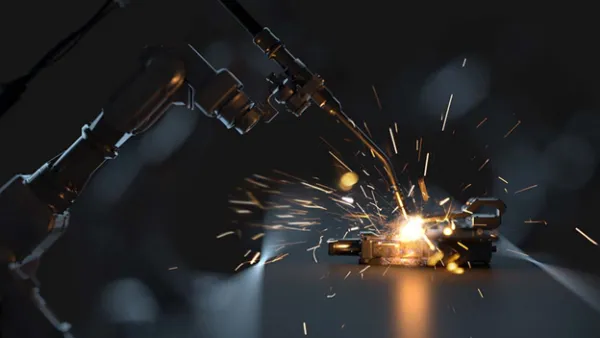
Before delving into details, it’s important to understand what a welding robot is. A welding robot is a programmable device specifically engineered for performing welding tasks. Robotic welding relies on industrial automation to carry out the welding process. Essentially, robotic welding integrates welding techniques with artificial intelligence and sensors to achieve its functionality.
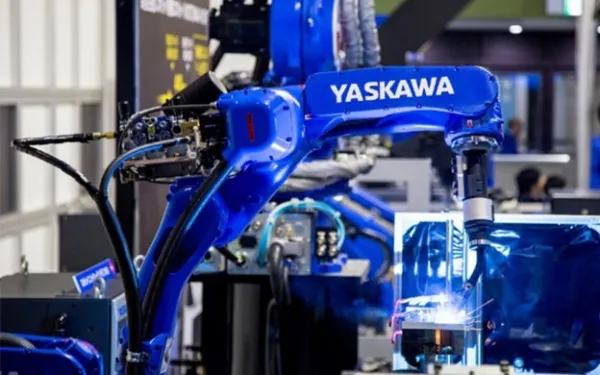
Robots can be integrated and programmed to move, articulate, cut, and joint workpieces. The welding automation systems use arms, machine vision, precise tools, sensors, and laser technology to enable three-dimensional welding for different and specific manufacturing needs.
Source: bosinnovations.com
An Overview of Robotic Welding Solutions
Today, robotic welding solution is recognized as the most popular industrial application of robotics worldwide. Its prominence is such that approximately 25% of all active industrial robots are utilized for welding operations. Moreover, studies indicate that over a quarter of the world’s welding robots are Yaskawa welding robots. The automotive industry is the most active sector employing robotic welding, accounting for roughly 40% of the global robot supply, followed by the electrical and electronics industry, which constitutes about 20% of the global robot supply.
As you know, driven by the need for higher product quality, improved productivity, and reduced costs, robotic welding solutions are becoming increasingly widespread. Additionally, the strong flexibility of production systems in adapting to dynamic market behaviors, which ensures product competitiveness, has prompted manufacturers to adopt robotic welding processes as an appealing alternative to traditional manual operations and hard automation.
Regarding the widespread adoption of robotic welding solutions, it suffices to say that since the first use of welding robots in industrial production in the early 1960s, robotic welding has expanded across a wide range of manufacturing sectors. Notably, between 2010 and 2013 alone, over 600,000 industrial robots were deployed worldwide.
Fundamentals of Robotic Welding
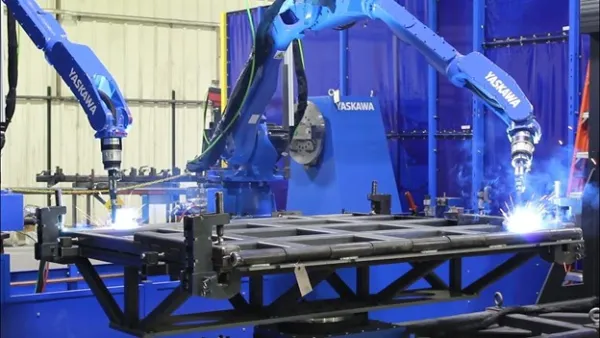
In this section, we will delve deeper into the mechanics of robotic welding solution systems. Generally, a basic robotic welding system consists of two main components:
-Welding Equipment: This component delivers energy from the welding machine to the workpiece.
-Robot: The role of this component is to provide the relative positioning of the heat source and the workpiece.
One of the most common types of these robots is the six-axis robot. Typically, industrial six-axis robots are designed with a three-axis arm and a three-axis wrist.
Recently, many robot manufacturers have designed welding robots to be smaller and more affordable than before, which has consequently reduced the capital required for selling robotic welding systems. Another recent advancement in welding robotics is the introduction of seven-axis robots, featuring an additional axis in the lower arm that enhances flexibility and provides greater floor space savings.
Welding Expertise
When it comes to robotic welding systems, the best approach is to utilize automation and robotics solutions in the industry. Our customers are typically leaders in construction, energy, agriculture, transportation, shipbuilding, oil and gas, aerospace, automotive, and more. Simply connect with our consultants and let us know what you’re looking for—we’ll be happy to provide you with tailored solutions to meet your specific needs.
Advantages of Robotic Welding Solutions
Robotic welding provides a range of advantages over traditional methods, including:
Speed and Efficiency
Robotic welding systems operate at exceptional speed and efficiency. Unlike human welders, robots work continuously without fatigue, ensuring optimal throughput.
High Quality and Consistency
Robots deliver consistently high weld quality thanks to precision programming and scientific algorithms, minimizing defects and variations.
Improved Workplace Safety
Since robotic systems work in enclosed areas with no human involvement during operation, they significantly reduce workplace health and safety risks.
Reliable MIG/MAG Welding Performance
Robotic MIG/MAG (gas-shielded) welding systems offer outstanding repeatability and quality. These systems can operate continuously across multiple shifts with minimal downtime.
Smart and Easy Process Setup
Setting up advanced robotic welding processes is simplified through smart sensors, mobile apps, augmented reality, the Internet of Things (IoT), and machine learning (AI).
Real-Time Interaction with the Environment
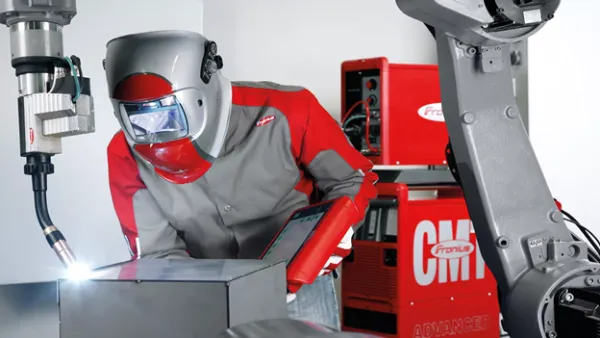
Robotic systems can interact with their environment in real time, at speeds measured in milliseconds. This capability allows for dynamic variable management, enabling the robot to adjust its actions based on changing inputs. As a result, the welding process can be flexibly modified across a wide operational range.
Welding of Heavy Components
Robotic welding systems can continuously work on heavy-duty components with high welding speeds and excellent seam quality. This makes them ideal for demanding industrial applications that require uninterrupted performance and strength.
Operation in Uneven or Hard-to-Reach Areas
Welding robots are well-suited for working in elevated, vertical, or irregular surfaces where manual access to the weld point is ergonomically challenging or unsafe for human operators. They ensure high precision and consistency even in such complex environments.
Enhanced Accessibility to Confined Spaces
These robotic systems can easily reach tight and narrow areas, such as the small gaps between beams or structural elements, where human entry is not feasible. This makes them particularly useful for applications that require precision welding in confined or obstructed environments.
Repeatability and Precision
The repeatability of robotic welding processes is exceptionally high and precise, with accuracy up to 0.05 millimeters. While human repeatability cannot be precisely measured, highly skilled welders typically achieve only about 5 to 10 millimeters of accuracy. Therefore, robotic welding is significantly more precise than any manual welding.
Applying welding parameters (WPS, PQR) with high accuracy and repeatability on workpieces is only achievable with robots.
Contrary to common belief, robots are not limited to welding single-type products or mass-production processes. They can be easily programmed to handle workpieces with continuously varying characteristics.
After programming, robots can repeatedly perform gas welding on well-fixed parts without requiring special sensors or sensing technology.
Path Tracking Technology
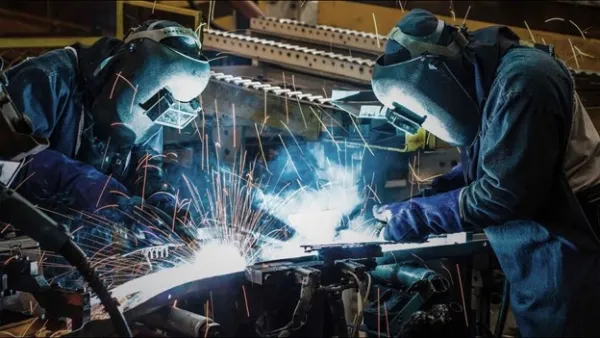
Welding path tracking can be enhanced using Touch Sense technology. This system operates without requiring changes to the robot’s program and helps detect positional deviations on the workpiece. The pre-programmed robot automatically adjusts its welding path by analyzing the detected deviation.
Robots can also detect changing welding paths using intelligent sensors and software such as laser tracking sensors, Comarc arc tracking software, and ArcSense. These systems automatically determine and apply necessary program modifications.
Quality Control and Testing in Robotic MIG/MAG Welding
In robotic MIG/MAG welding, product and process verification according to quality standards—including ultrasonic testing (UT), radiographic testing (RT), and destructive inspections—is much easier and more feasible than conventional methods.
Robotic systems reliably create parameter sets like WPS and PQR with absolute success. They outperform traditional welding methods in critical areas such as ideal seam thickness, penetration, pore elimination, microstructure quality, and aesthetic appearance.
Durability and Continuous Operation
Robots can operate continuously for 80,000 to 100,000 hours with only basic maintenance and without errors. Additionally, robots do not suffer from fatigue. They can provide 24/7 service for many years, provided that maintenance is performed regularly and scientifically.
Our Customer-Centric Process
Tajhiz Sanat Robot Company is ready to serve you with the best and highest quality products. Our process of building custom robotic cells is tailored according to your needs. Our team considers your business goals, business processes, and production requirements to provide services accordingly. We collaborate with you at every stage—from concept to delivery.
At TS GROUP, our goal is to establish a long-term partnership. Your success is our success. Even after delivery, we are prepared and committed to providing any training, support, and services you may need.
Robotic Welding Solutions by Tajhiz Sanat Robot include the following:
-Robotic MIG/MAG Welding Solutions
-Robotic TIG Welding Solutions
-Robotic Laser Welding Solutions
Advantages of Robotic Welding Solutions by Tajhiz Sanat Robot:
-Providing suitable robotic welding systems to transition from manual welding processes to robotic welding.
Minimal need for adjustments and programming.-
Utilizing Yaskawa welding robots from Japan.-
Fast delivery.-
Compact installation footprint, saving valuable floor space.-
-Use of Japanese and European equipment for executing robotic welding projects.
Employing Fronius and Lorch robotic welding machines.-
-Simulation of robotic welding projects to showcase the design.
Use of laser path-tracking sensors when needed.-
-Solutions tailored equally for small, medium, and large manufacturers.
Use of trackers for linear movement and single- or multi-axis positioners.-
Fully integrated welding and vision solutions.-
Custom design and manufacturing of tools, jigs, and fixtures.-
TS Group and Robotic Welding Solutions
In this article, we discussed one of the most widely used applications of industrial robots — robotic welding solutions. The welding robot is the most critical component of a welding system.
Tajhiz Sanat Robot Company utilizes Yaskawa welding robots from Japan in its robotic welding systems.
For nearly a decade, TS Group has been implementing automation and robotics integration at the highest level within the industry. When it comes to completing automation in your business, we offer you the best robotic welding systems.
The TS Group team, composed of automation, robotics, and welding experts, leverages nearly a decade of advanced knowledge in welding, design, development, and programming. We specialize in creating robotic welding automation solutions for industrial customers involved in product manufacturing.
TS Group has taken modern welding automation to the next level with features. such as automated weld programming, collision avoidance, and robotic vision, enabling us to solve complex welding automation challenges.
FAQ
-What is a Robotic Welding Solution?
A robotic welding solution is an automated system that uses robotic arms to perform welding tasks. These systems are programmed to weld components with precision, consistency, and speed, making them highly suitable for high-volume production.
What are the benefits of using a robotic welding system?
Robotic welding helps increase productivity, improve weld quality, reduce human error, and enhance workplace safety. Additionally, this system lowers labor costs and enables more effective execution of complex welds.